Posted in Uncategorized

Dr. G’s #WestAfricanJourneyTravels!!-Day 6-Day of Remembrance and a Little Shopping :-)

Day 6 of my #WestAfricanJourneyTravels visit was quite a full day but one that incorporates legacy and remembrance as well as a little hustle and bustle! By the end of the day, I was completely full and drained at the same time!

Alright my friends, let me drop this bit of information in the post before we go any further.

  • So the African Renaissance Monument is the second-tallest topped out structure in the world that you can go in (#1 is the Palais Royale in Mumbai, India and #3 is the Empire State Building in New York, United States), and the tallest statue in Africa
  • Overlooking the Atlantic Ocean, it is 52 meters tall (171 ft.) statue made completely of bronze and is located on top of one of the twin hills (Collines des Mamelles) outside of Dakar
  • Preparation began in 2006, construction in 2008, and completion in early 2010 with a formal ceremony on April 4, 2010…which is also Senegal’s “National Day” celebrating the 50th anniversary of their independence from France.
  • On the day of the ceremony, there would be 19 African heads of state present for the unveiling including the Presidents of Malawi, Benin, Cape Verde, Republic of Congo, Ivory Coast, The Gambia, Liberia, Mali, Mauritania, and Zimbabwe. There would also be representatives in attendance such as Jesse Jackson, Akon, and representation from North Korea. Truly a moment to show honor and unity.

Now before going inside you had two options of how to get in….climb the stairs or take a taxi going up the back entrance….You already know what I did, I took the stairs!! It was no small feat but one of my friends and I made the 198-step climb to the top in just under six and a half minutes (you can see us below). Talk about feeling accomplished.
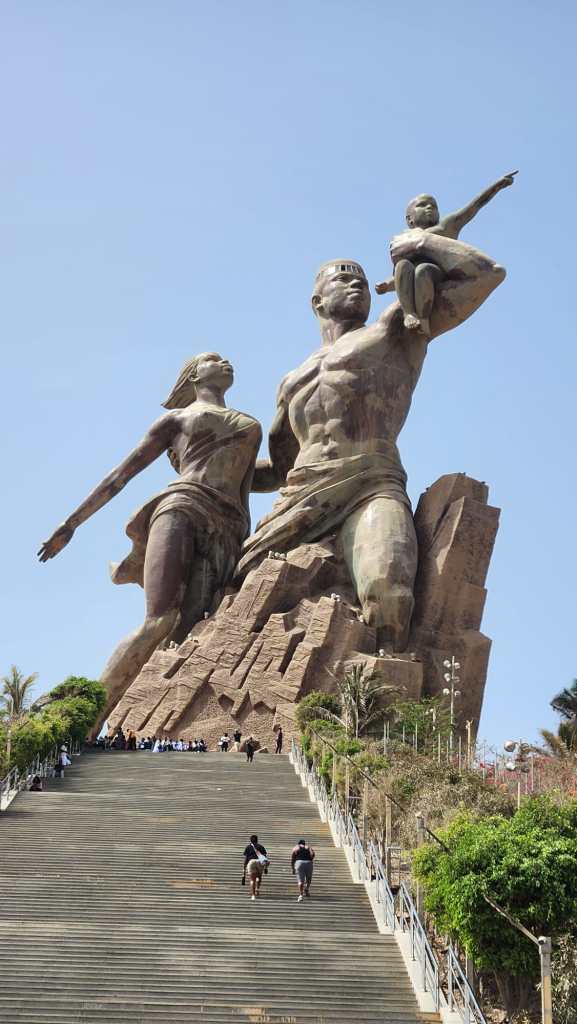
The above pictures not only shows the stair path up to the top, but the actually monument itself is quite a sight to see. The creation of this project was initiated by the then Senegalese president Abdoulaye Wade and has been described as one of the most prestigious projects. Named the African Renaissance Monument, it served as a marker to usher in a new era of African Renaissance. It is a literal visual of moving from enslavement to renaissance. Now what you see is a family looking towards the sky (or one might say the future), the man is carrying his child on his bicep/arm and holding his wife by the waist. They have come from the depths of the earth and going towards new life. What an inspiring imagery and one that more people should know about. I will be honest I knew very little about the monument, but so glad that I made the journey to see live and in living color!!

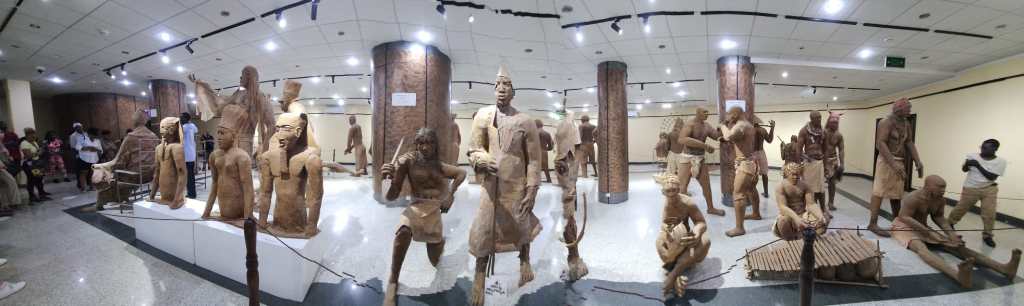
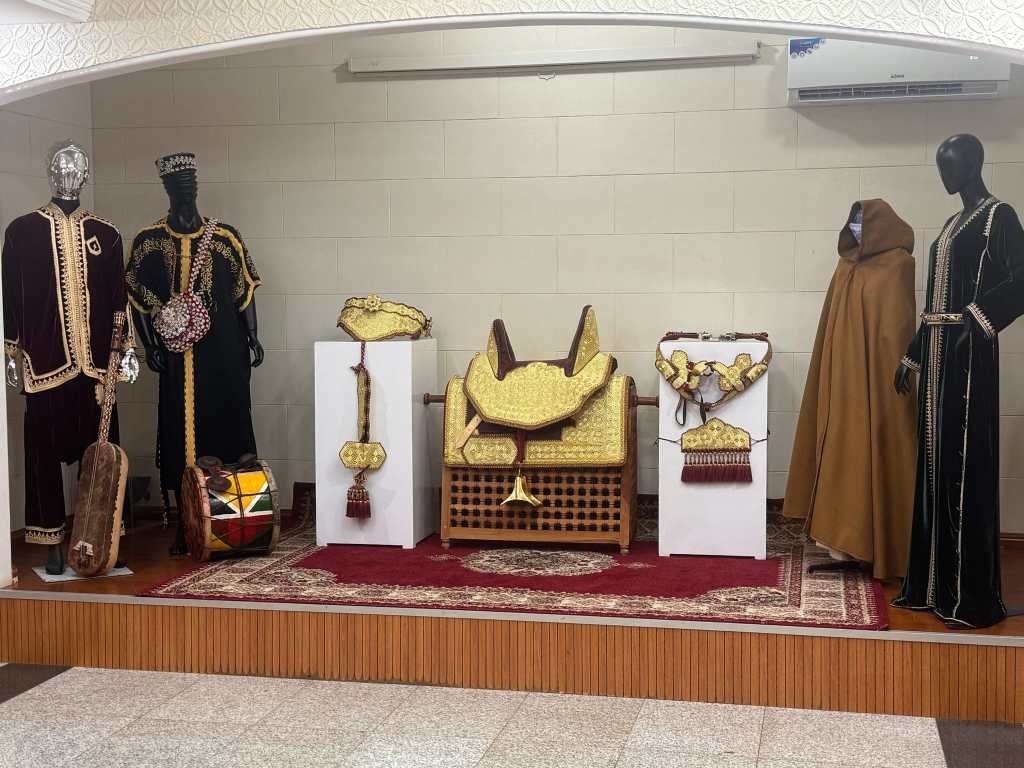
Once inside visitors can see various videos showing the building process, acknowledgment to the “door of no return”, the history of enslavement and its global impact, the many gifts donated from numerous African countries, and at the top of the monument which is housed in the man head you can look out into the city. There were about 5 levels full of various gifts from many African countries, which was truly inspiring !! To see community building from near and far speaks to what can happen as a collective unit.
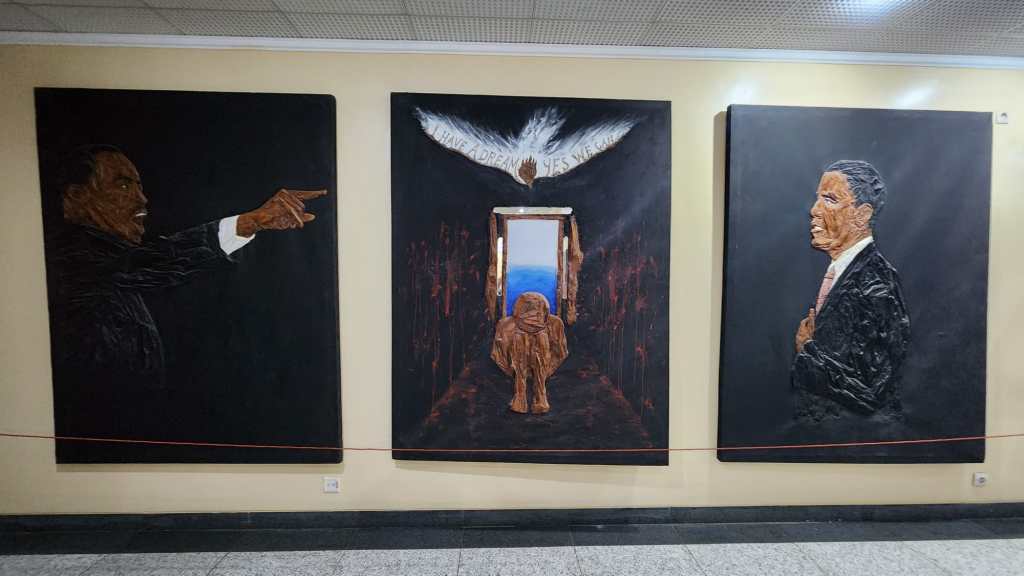
Door of No Return interpretation
Top view from the African Renaissance Monument

Quite a powerful structure and amazed at how much of a message is being conveyed! When looking at the woman in the monument she also offers an intriguing thought, particularly to her child in that even when looking to the future, don’t forget your past!

What I do find interesting is that everything surrounding the monument is either unfinished and/or underdeveloped. It makes you think this massive structure sits in a space where depending on your perspective it is either out of place or the start of something new and fresh.


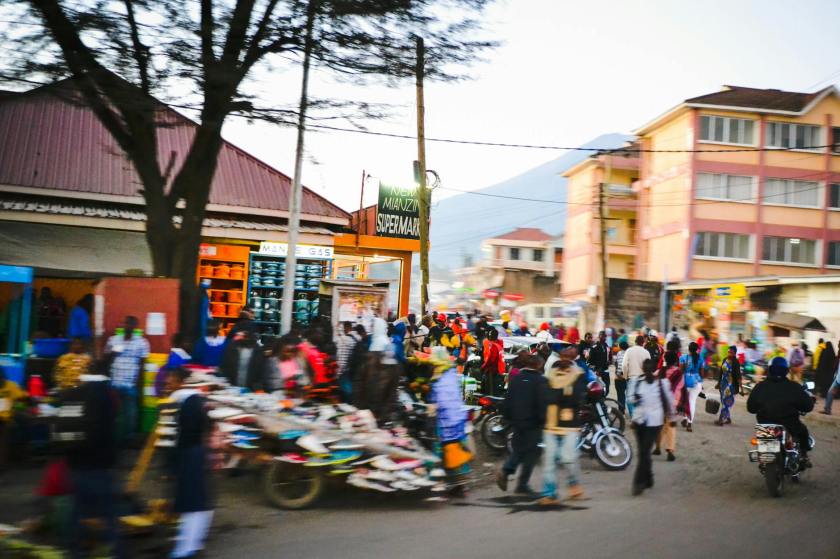
To close out the day we went to a traditional Senegalese market to do a little shopping. Now let me just say this, I’m not one to haggle and negotiate. I have a price in my head of how much I want to spend and that’s the parameters I work with to get to the end goal. This is a wholesale marketplace, which means many vendors come here to get there supply and then go to their respective places and sell same said items, typically at a marked up price. The build had to have at least 5 levels, and talk about being overwhelmed, filled with anxiety, and willing to walk right out the door. But let me give a major shout out to our trip facilitator Dr. Kentaya Beeler (#TranquilityPathwaysTravel) who has the haggling game on lock!! I literally watched her find a specific vendor/seller, select her items, grab a seat, and the games began!! It was like watching a master at work, when she quoted a price that was what it was going to be, no ifs ands or buts about it. It takes a special skill to make the magic happen that she did. It was to a point that I became worn just watching it all unfold. I guess I am just used to going to a store finding the sale rack and making my purchase. Talk about being in awe! She was going toe to toe with these men and turning “water into wine.” And I thank her, because she definitely got me some EXCELLENT deals!! All in all, it takes a certain mindset to participate and take the necessary steps for some retail action.

Sidenote: Once again traveling on these Senegalese streets is quite an adventure. I am still blown away by the way locals navigate the roads, whether in a bus like us, traveling on a motorcycle taxi, a bicycle, walking, or even horse and buggy. On MANY occasions I saw my life pass before my eyes. The fearless mentality is beyond my understanding. What I witnessed morning, noon, and night is aggressive driving to the tenth power!! And somehow there were no accidents….

All in all, while it was quite a long day especially when you factor in the travel, it truly did my spirit good!

Closing out the evening with a nice warm cup of Senegalese coffee…Mmmm good!!

ONE MORE DAY LEFT!!

You know what’s next, see you soon! ~Dr. G

Posted in A Professor's Thoughts..., Dr. G's Travels

Dr. G’s #WestAfricanJourneyTravels!!-Day 4: You May Apologize but We Never Forget!

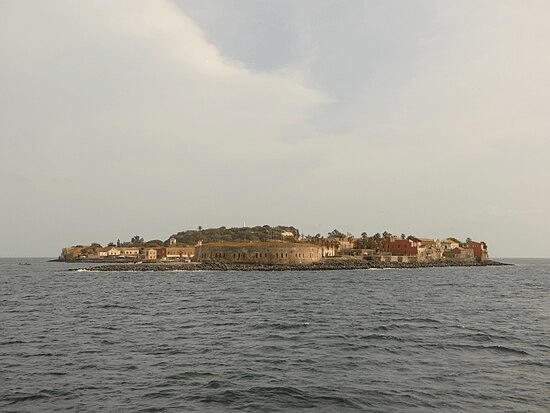
So I know it’s a little later than normal, but yesterday was quite a heavy day as we ventured across the waters to Gorée Island, which is an island off the coast of Senegal opposite of Dakar the capital city. A little background about Gorée Island:

  • Gorée was a central trading post especially for slavery as it would be the largest slave trading center on the African coast
  • Gorée was the name given by the French colonials which means dignity
  • Wolof is the primary language spoken on the island
  • The Gorée Island was designated a historic site in 1944, with safeguarding measures following in 1951, and then inscribed as a national heritage site protected by UNESCO in 1978
  • The first inhabitants came to the island in 1500 which were the Portuguese then the Dutch, and lastly France
  • The first Black man in the French Parliament was born on the island
  • Once the slave trade stopped on the island colonization would end as well

Now I knew going in that it would be a lot to take in so I prepared myself ahead of time, but even with preparation you still can never be fully prepared. To walk in the space, breathe in the air, literally go out of the “Door of No Return” I got chills up my spine, its a feeling you do not forget. As I was typing this up I had to pause several times because I got angry over and over, but I pushed through!!

Dr. G traveling on a barge boat to Gorée Island

Once again we had an OUTSTANDING guide, Mr. Diallo, throughout the island. In many ways he reminded me of a guide when I went to Robben Island in South African. His honesty and candor really made the experience complete. Trust me it is not an easy task, I almost wonder what this experience means for him, especially when the group of people are primarily African Americans. This is not just another excursion for us it is an opportunity to in many ways course-correct and carry forth the memories and voices of those who did make it past the raging waters. I get real sensitive about this because many want to minimize the stories and treatment, act as if the torture did not exist, or tell me it’s over now you are free you should be happy…however this is far from the case (but that’s another lesson for another day).

Our guide on Goree Island, Mr. Diallo providing a great deal of knowledge

Continuing forward, I appreciate the time and work that guides like Mr. Diallo take to tell these stories, because trust me they are not easy hear. And one thing that he would say that stuck with me for the entire trip was when he made the statement “apologize but never forget.” He would actually say this on more than one occasion (four times to be exact). So I am going to be frank here for a second, while I acknowledge the apologies that have come from various individuals, that is simply not enough. It is what you do after the apology that really is the true work and testament. Apologies can be dished out like pouring a glass of water, what are you going to do after that because an apology holds no weight if just left to fall to the ground. While I know everyone does want to travel to the continent (particularly African Americans), it is still necessary to be informed so that no one else can tell you our history and story.

Before going through the door of no return, you enter what is called the House of Slaves (La Maison des Esclaves), now get this on the top level the European traders would stay on the top level drinking and dining with each other, many times without their wives. As they would often be found raping many of the African women. Let’s keep in mind, that these activities also took place throughout the island, BUT in this particular space, it is even more disturbing.

House of Slaves (La Maison des Esclaves)

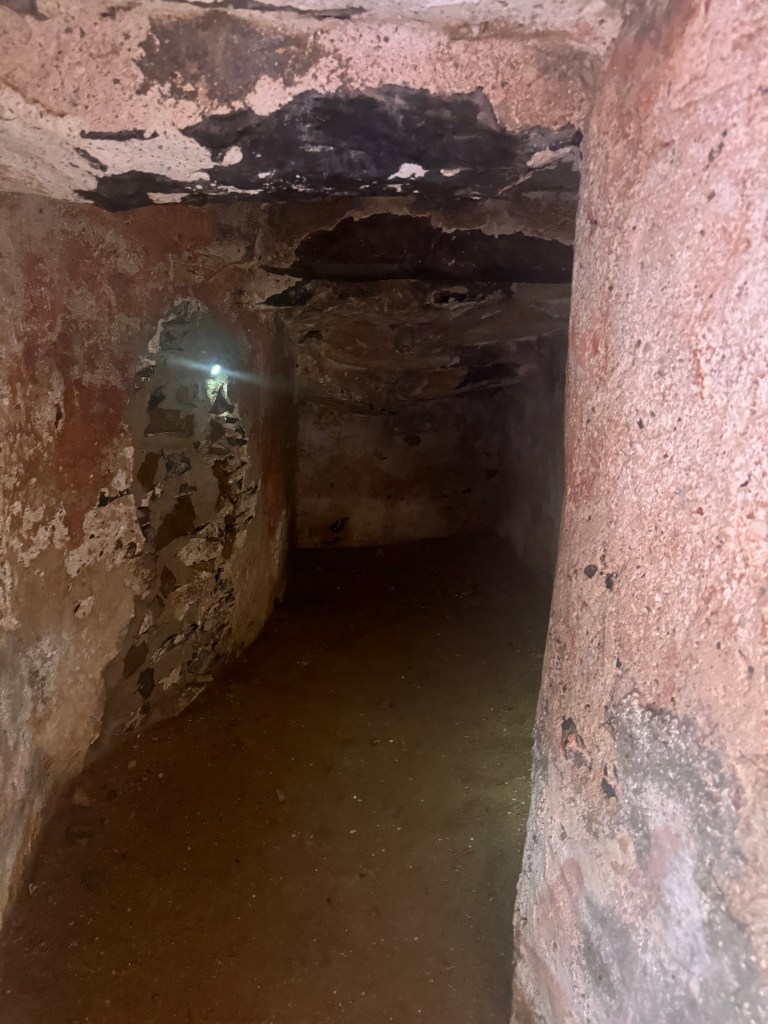
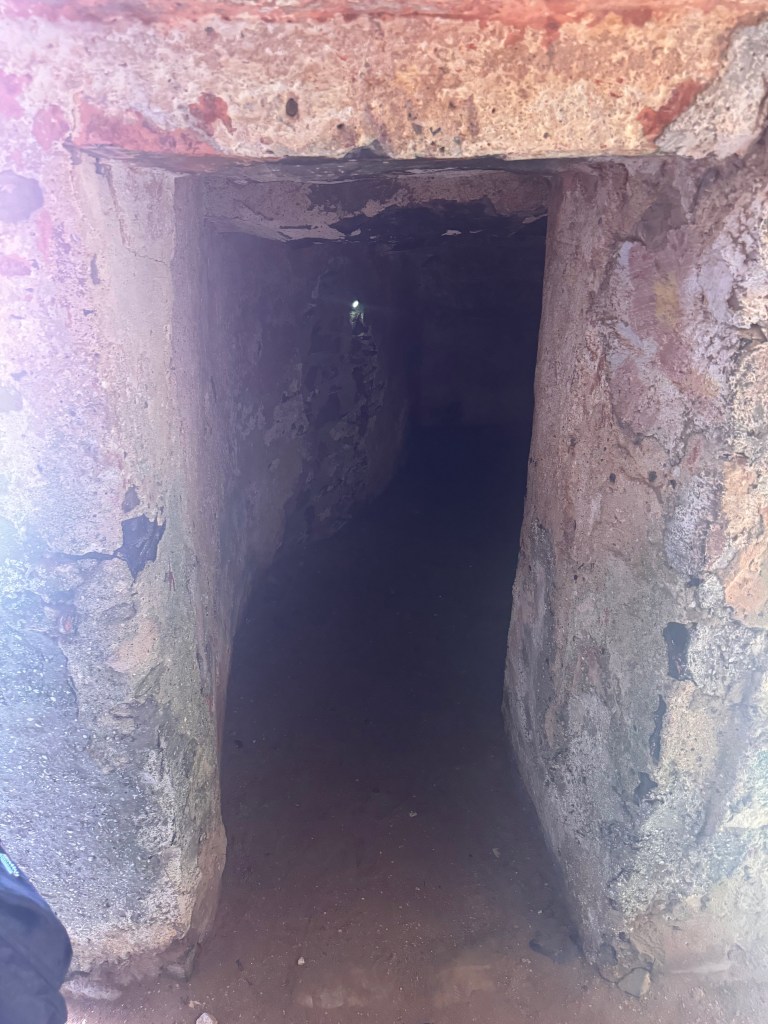
In this same building (that held at times 150 enslaved Africans) below you would find rooms with barely any light or window space made of stone that housed the enslaved Africans before they boarded them on the ships like cargo. In the rooms, they were fed so that they could be at least 60kg, if they did not make weight they were fed until they did. Now it’s not like these were hotel rooms with plush beds and a bathroom, no ma’am no sir…an open area that had a metal gate door. Some of the rooms which measured at 2.6 meters x 2.6 meters crammed as many as 30-40 children or 15-20 adults. I cannot even begin to imagine what that would do to one’s psyche. AND WHY?? How is that humane?But then again when you do not see anything wrong or you think Africans are less than….welp…Let me tell you, I’m claustrophobic and I know it would have been a wrap for me!!

Here’s the part of the narrative that took me even longer to process…Let me drop a number 6 MILLION…by 1848 that is how many had died and never returned to their homes in which they were taken…So MANY  painful memories of the Atlantic slave trade are housed in this place, and while many people live and work on this island today it is still considered a major remnant of the slave trade.

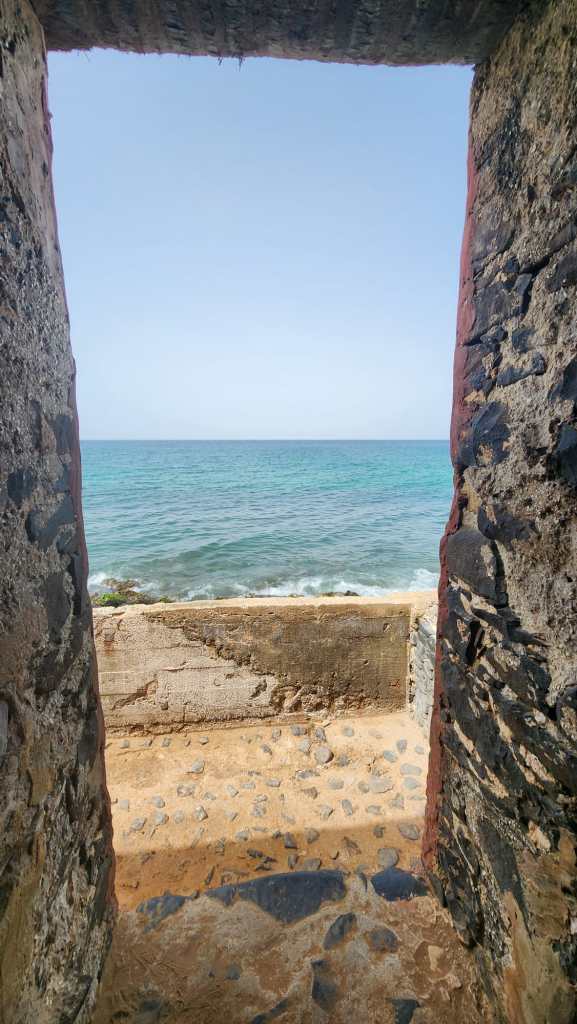
Looking out the Door of No Return

Just taking it all in… Mercy Mercy Me

Door of No Return…Looking out to the ocean…

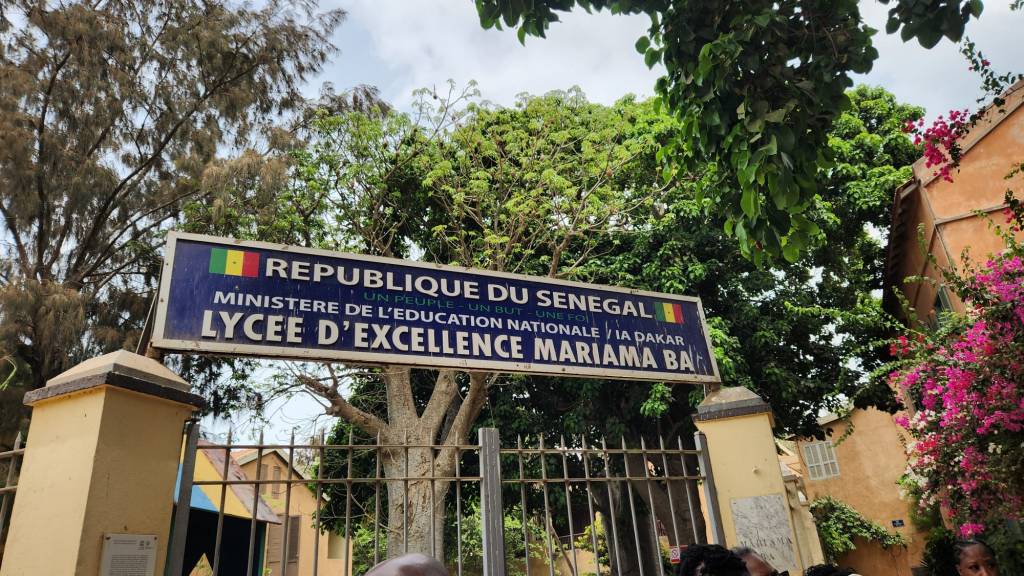
Even amid the enslavement horrors, there are glimmers of hope and success that can be found on the island. On a lighter note, I would learn of this particular boarding school Mariama Ba School of Excellence (pictured below) on the island which is one of the most prestigious schools in Senegal and dedicated to the education of young girls. The school was founded on the idea of ​​Colette Hubert Senghor, the wife of Léopold Sedhar Senghor – the first Senegalese President following independence – who had been educated at the Legion of Honour boarding school in France. As a public boarding school it welcomes 250 young girls from 6th grade to 12th grade. Of that 35 girls are selected and brought to universities in the U.S., Canada, and Europe with a 100% success rate. A school exclusively dedicated to girls, the aim is to train “the country’s elite.” To learn more about the school see here!

Now hearing about this school warmed my heart and was a much needed pick me up!


On a side note, before I close out, let me tell these ladies who are selling their goods on the island take hustling to a whole new level! I have never been so overwhelmed and filled with anxiety, we barely could get through the tour with them right on our heels. And while I respect the hustle a part of me wanted to not be treated as a tourist and enjoy what the island had to offer…a rich history and many stories to tell.


With that said…Interestingly enough, despite the pain and trauma Gorée Island also serves as a place of respite and inspiration for many. For some, particularly us on this trip, the island is now a pilgrimage destination for the African diaspora, a bridge between the West and Africa, a space for exchange and dialogue between cultures, and a place for reconciliation and forgiveness. I will be honest I am personally still working on that last part.

Dr. G standing outside of the door of no return and looking to where my ancestors were once forced out to foreign lands (Gorée Island-Senegal)

Now while this day was filled with a lot of heavy emotions, I can say that in the end I truly hope that I am making my ancestors proud and staying dedicated to making sure their stories are not silenced. And if there is one thing I want folks to take away from this is that regardless of the torture, pain, and inhumane treatment, their voices will never be lost. The Atlantic Ocean carries the spirits and they refuse to be dismissed. And as long as there is breath in my body, conviction in my soul, and a desire to teach my ancestors and their journey will ALWAYS be a part of the global narrative.

Alright, good people! Until the next time, I will see you soon!! ~Dr. G

Posted in A Professor's Thoughts..., Black Joy, Dr. G's Travels

Dr. G’s #WestAfricanJourneyTravels!!-Day 3: Safari Time!!

I’m back with another day of adventure!!

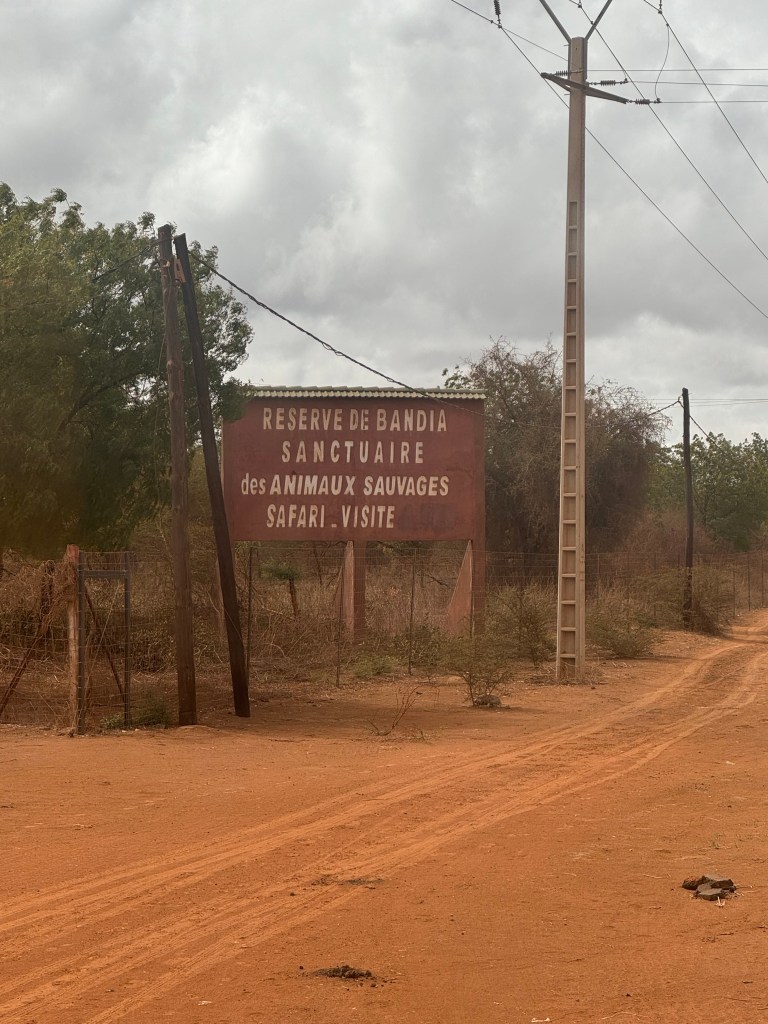
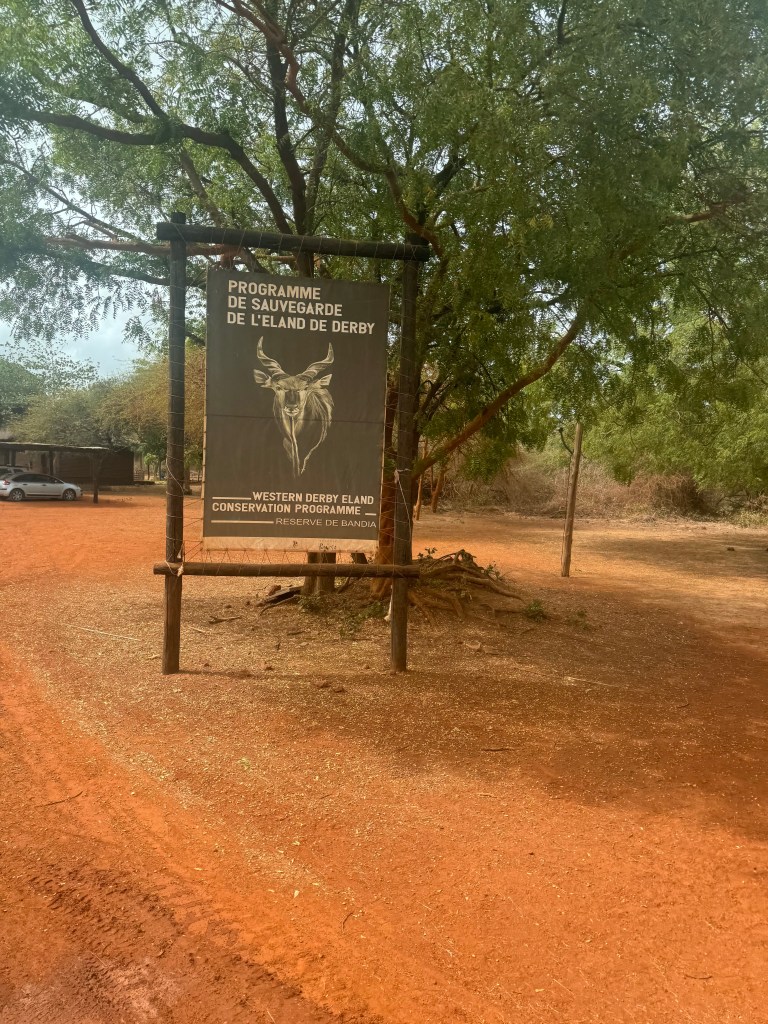
So on today’s agenda, we did an excursion trip to the Bandia Reserve (which is Senegal’s first private animal reserve) for a safari trip. And let me first start out by saying I really appreciate all of the different types of safari’s that I have done because each one provides a new experience. Oftentimes when one does a safari you are in the natural environment of the animals (basically their turf), so they are nearly as accessible. This is partly because it is survival of the fittest. This one in particular provided a chance to see many of the animals up-close and personal.

Our reserve guide Malat was definitely on point!! He had all the facts down to a tee!! And he even had a few tricks on how to find where the animals were throughout the reserve. I noticed throughout the drive he would always look at the ground. Come to find out instead of using a walkie-talkie or cell phone, he went old school and tracked them by their footprints.

Dr. G with our Reserve Guide Malat

Now here is what you’ve been waiting on for this post…A few of the animals, we got to see we either had a chance to have a heart to heart or a very close encounter, check it below:

Now these rhinoceros are what I like to think of as gentle giants until you mess with their food. For the most part, they mind their business, however, we would witness one literally scare off some antelope during its feeding time. The one monkey next to him somehow managed to stick around probably because he was less of a threat with its food.

Feeding time for the rhino

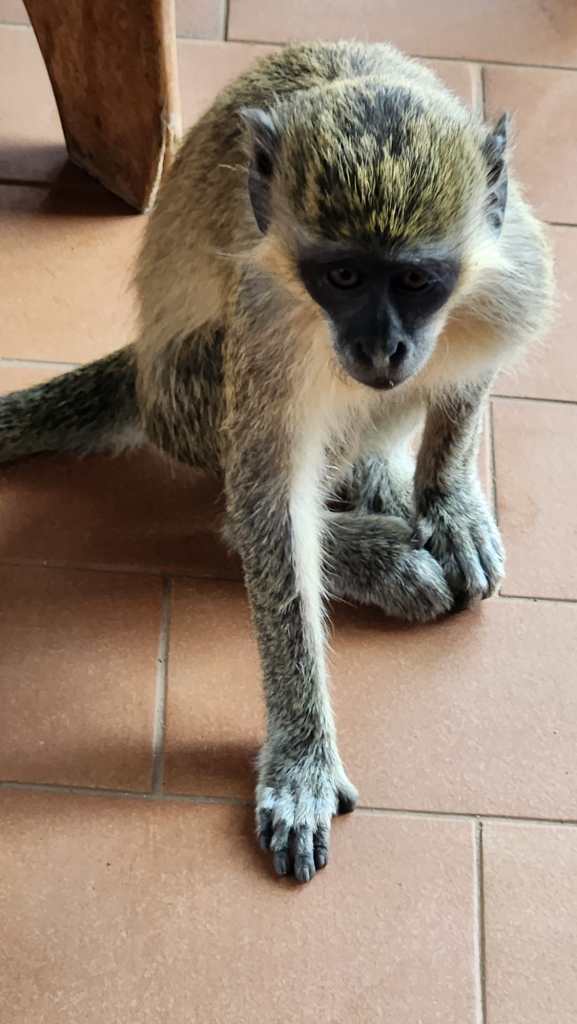
Let me tell you these monkeys have NO FEAR and will snatch your food in a heartbeat!! One snatched a slice of pizza and another a sugar sweetener packet!

Dr. G having a brief conversation with one of the monkeys on the reserve.

Now who all remembers Zazu from The Lion King? Well, we got to see him and let’s just say the movie did a great interpretation!

“Zazu” also known as a Red-billed Hornbill

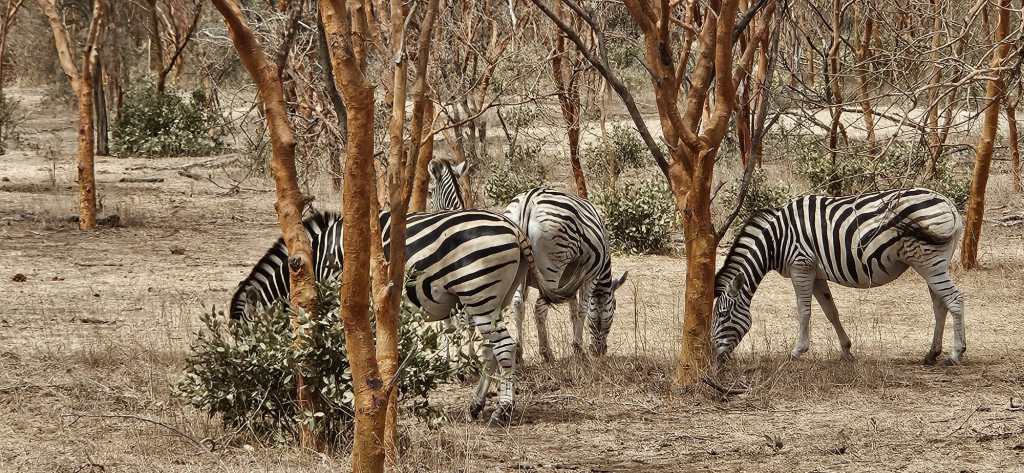
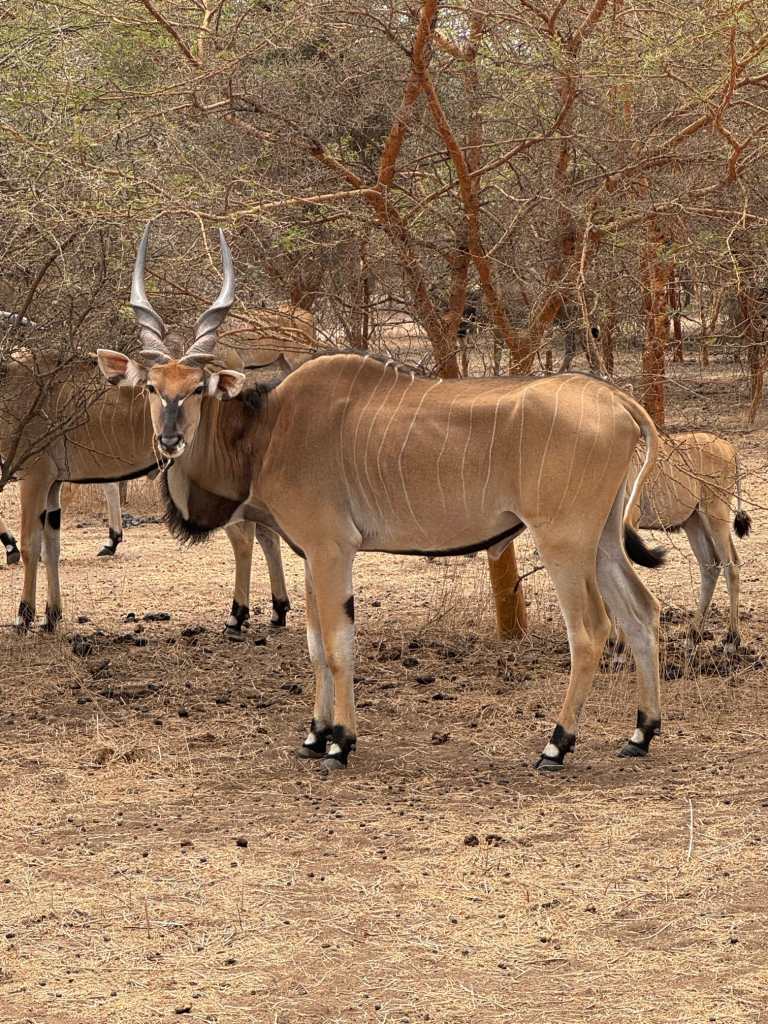
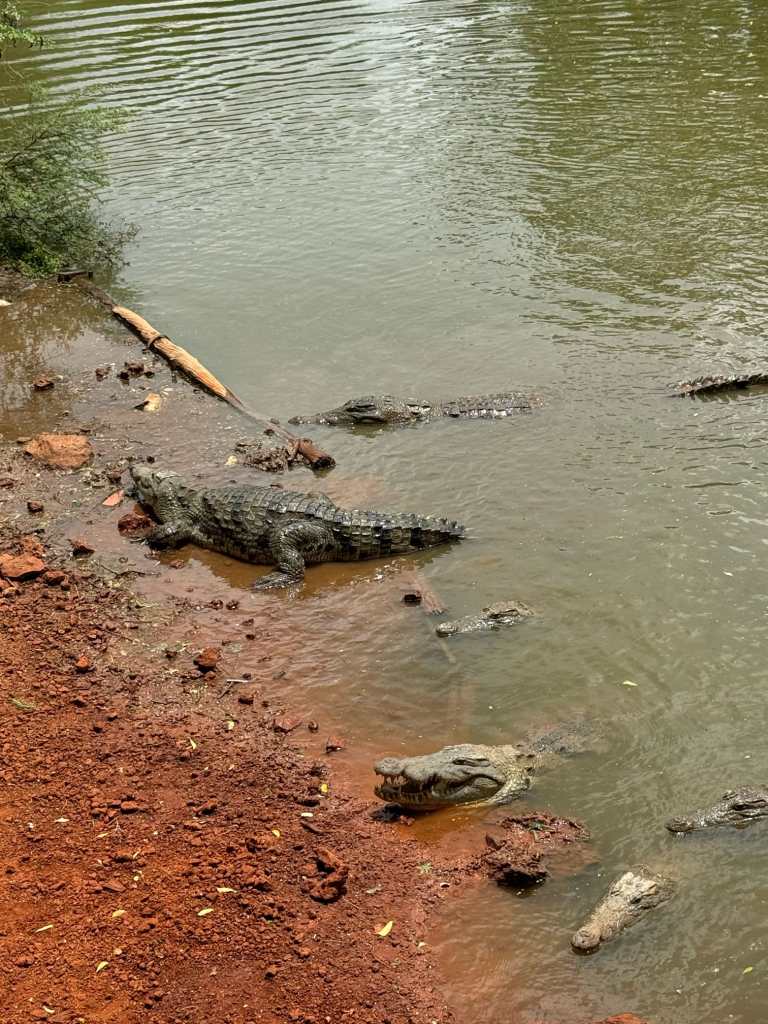
We also got to see zebra, various antelope, crocodiles, ostrich, impalas, warthogs, and giraffes, and more…

In addition to the animals, I would learn a great deal about the Baobab tree. Let me just say…WOW… these trees are some resilient forces of nature!! They are considered a central symbol of Senegal and some of them can hold as much as 10,000 liters of water during the rainy season. These fascinating creatures of nature can live up to 1500-2000 years old. Their roots are very shallow and even when they split or somehow break, they still manage to grow even if it is sideways.

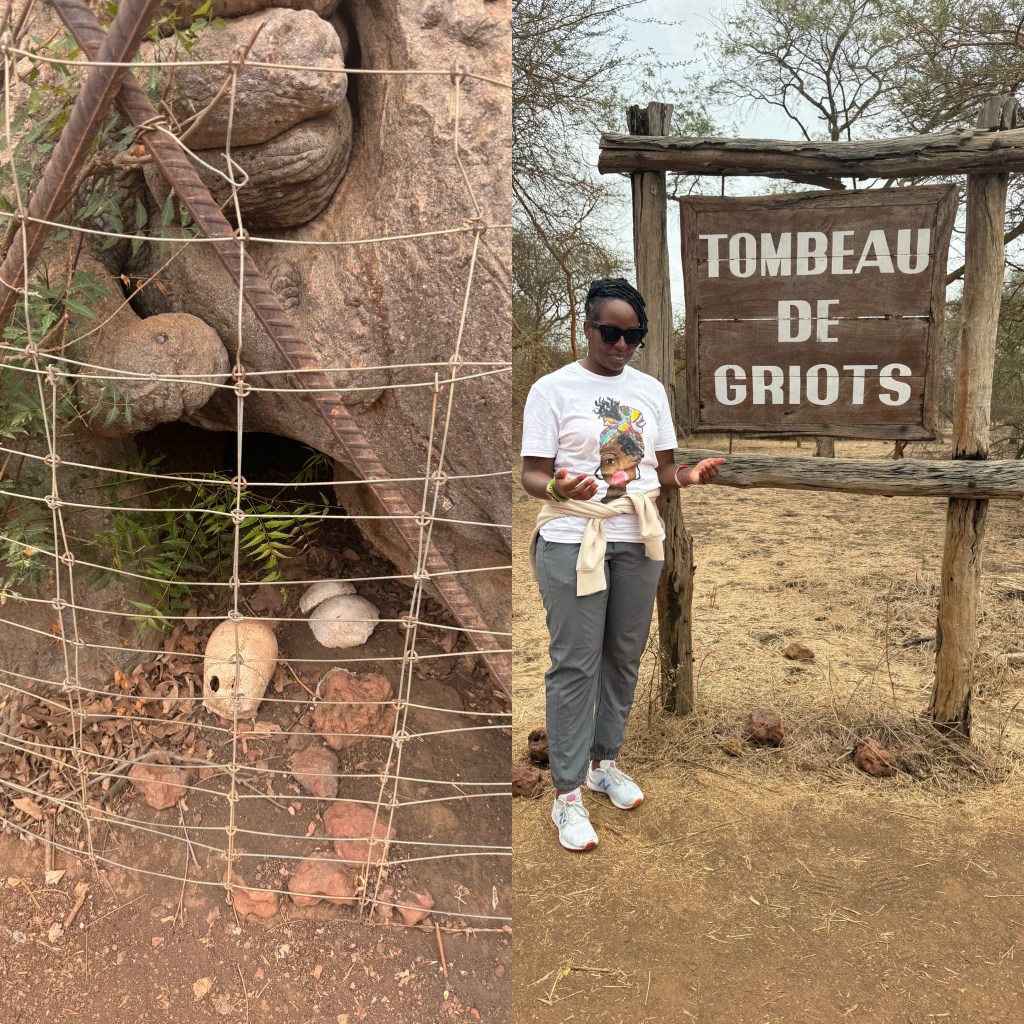
The above tree is a significant one as there have been over 600+ griots buried within this tree. Now you are probably asking what do you mean buried? It’s an extraordinary feeling to know that you are amongst a collective of storytellers who played a role in preserving the culture. Griots played a significant role in oral history making sure the stories are passed down through generations. They served as a vessel of resistance for those who were against certain religions and cultural traditions, and a way to push back against French colonization. If there was a problem in the community, the griots would facilitate some type of resolution and restore order. As a repository of knowledge it was only right that they would be buried inside a baobab [also known as the tree of life], that their history would live on just like the baobab tree.

The literal lived realities and collective journeys of ancestors can be found here. And you will see me repeat this alot, it is essential that all voices are heard, acknowledged, and recognized, especially those of the African diaspora. Far too long land and culture is stolen or erased. Thus, stories tied to the land become important. Our guide Malat would share with us that if a griot was buried under ground, there would be no rain. Sharing that in the 1960s, soon after Senegalese independence, the government imposed egalitarianism, this resulted in banning spiritual practices of burial, which forced Serer people to bury the griots underground. It is said that in the same year there was a drought. While I do not have complete/exact information on this, one can find a history of droughts causing major famines in the region throughout the 1960s.

Dr. G paying respects to the ancestors who have transitioned back to the roots.

Now you know I gotta drop some interesting facts for you:

  • While the official language of Senegal is French (due to French colonization) the most widely spoken language is Wolof. [All those years of French in K-12 and college paid off some :-)]
  • There are only 3 white rhinoceros in the entire country of Senegal and two of them (male and female) are housed in the Bandia Reserve (see above).
  • The Baobab tree not only can live practically numerous lifetimes, but also as sources of food, water, and health remedies. The roots and the fruits are edible, the leaves can be eaten as a relish, cooked in a sauce, dried and powdered, and can even be good for women and their lady parts.
  • The Bandia Reserve was established in 1987 and was 400 ha (hectares) [equivalent to 989 acres] and now it has grown to 3500 ha [approximately 8,649 acres]
  • Riding on some of the roads, I felt like I was back in Georgia looking at all the red clay dirt (see some of the above pics)…and once again it made sense why white colonizers took Africans to familiar environmental/ecological settings…While enslaved folks did not realize that was what was happening the traders definitely did!!

As the excursion came to a close there were a few things that I did find very interesting…

  • No one really uses GPS it’s as if everyone just knows where to go and how to get there
  • No stoplights, stop signs, or street signs…As a visual learner and driver, I could probably manage to a degree once I learn the places, but the initial learning would be the tricky part. Talk about Jesus take the wheel! Can you imagine just pulling out onto the road, merging in however you can fit in? I would be a nervous wreck, but I guess if I were living there I would probably become a very aggressive driver.
  • There is a certain level of kindness that I saw in some of the people we encountered on today, just very chill , relax, and calm. Much like in Tanzania, the people here in Senegal embody a “Hakuna Matata” spirit.
  • This trip so far has further confirmed that I need to invest in some property abroad, quick and fast!! And what better place than in Africa!

As I close out for the day just wanted to share this joyful moment when some of the folks on the trip got a chance to purchase these AMAZING looking mangoes. And you would not believe the price… depending on the weight one could purchase 3 mangoes for what would be the equivalent of $1.60. Let’s just we would not even come close to getting that in the U.S. Gotta love supporting the local vendors. And don’t worry, I will check in with them and let you know how they taste.

Local street vendor selling mangoes

Oh and speaking of money here is some of the currency that you would find in Senegal:

Just a little bit of the West African CFA franc ($1.00 is equal to roughly 610 CFAs)

While the value may not be the same as the American dollar, the aesthetic (particularly African currency) is so much more appealing!!

Day 4’s post is going to be a heavy one, as we will be traveling to Goree Island which from the 15th to the 19th century was the largest slave-trading center on the African coast. It’s going to be a day that I will definitely have to further process and it will probably stick with me throughout the trip. But like Maya Angelou once said, “And Still I Rise!”

Photo by Papa birame Faye on Pexels.com

See you all soon!! Hope you all are enjoying the journey so far, and feel free to leave a comment below!! ~Dr. G

So glad I get to experience this with my Aunt Gloria